cost segregation
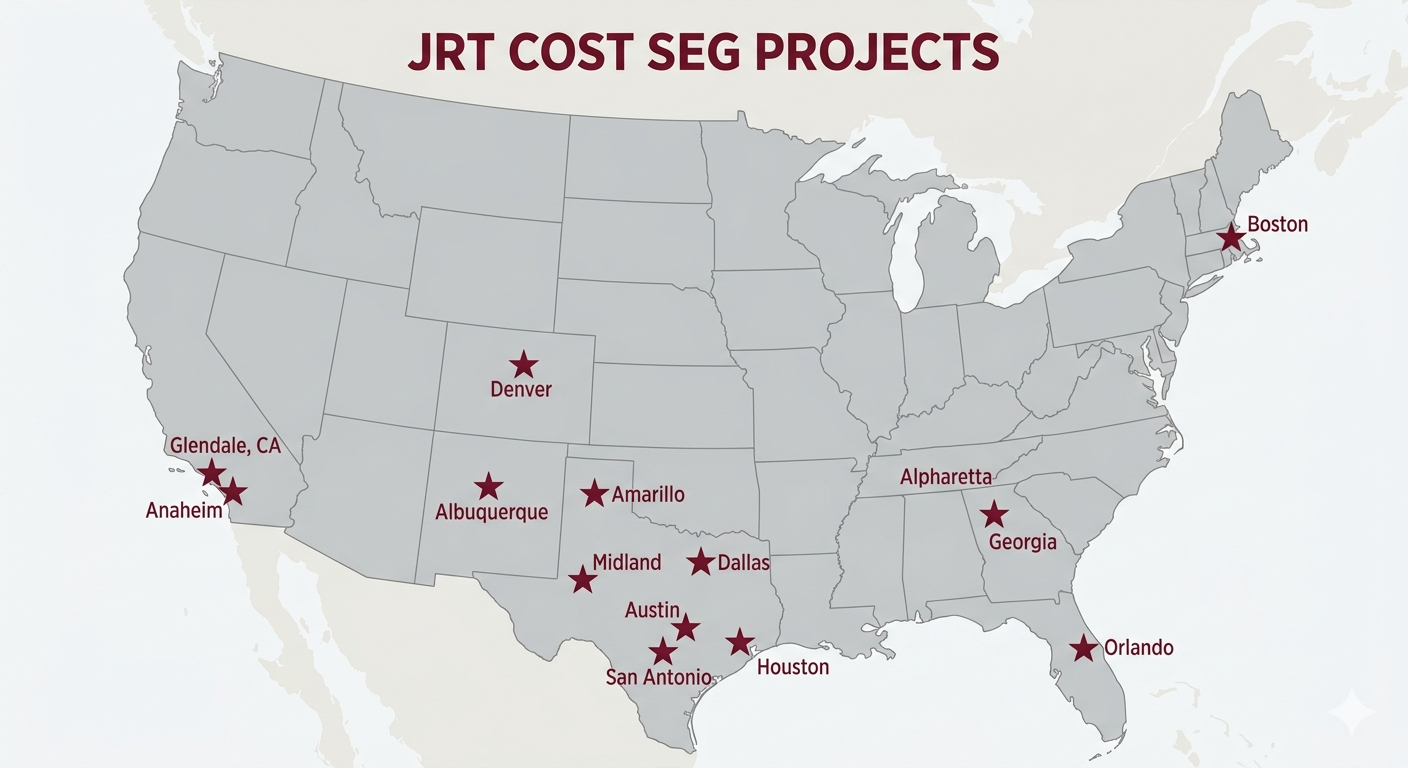
JRT has decades of experience performing accurate and meticulous cost segregation analysis across the United States. For property owners who recognize and appreciate the significant cash flow value that comes from tax savings resulting from accelerated depreciation deductions, we are fully prepared to provide a detailed proposal for your review.
JRT can provide turnkey service in coordination with local accounting firms or provide the study to your firm of choice.
Cost Seg Process
Cost segregation is a strategic tax-planning tool used by commercial real estate owners to accelerate depreciation deductions, defer income taxes, and significantly increase immediate cash flow.
Instead of depreciating an entire commercial building over the standard 39-year period (straight-line), a cost segregation study identifies and reclassifies specific portions of the property into shorter-lived asset categories, typically 5, 7, or 15 years.
The Core Value Proposition
The primary goal is to "front-load" depreciation. By moving deductions from the future into the present, owners benefit from the time value of money. A dollar of tax saved today is worth more than a dollar of tax saved 30 years from now.
The Service Process
A high-quality cost segregation service is typically "engineering-based," meaning it combines tax expertise with a physical construction analysis.
Feasibility Analysis: A preliminary estimate to determine if the potential tax savings outweigh the cost of the study.
Information Gathering: Review of blueprints, contractor invoices, ALTA surveys, and closing statements.
Site Inspection: A physical walk-through to document and photograph assets that qualify for shorter lives.
Cost Estimation & Allocation: Using engineering "take-offs" to calculate the precise cost of components (e.g., the exact linear footage of specialty crown molding or the cost of a reinforced concrete pad for machinery).
Legal Substantiation: Mapping every reclassified asset to specific IRS tax codes and court cases to ensure the study is "audit-proof."
Final Report: A detailed document used by the owner’s CPA to update the depreciation schedule (often involving IRS Form 3115 if the study is for a property owned in prior years).
Strategic Financial Benefits
Immediate Cash Flow: For every $1,000,000 in reclassified assets, an owner might realize $200,000 to $300,000 in additional first-year depreciation.
Bonus Depreciation: Under current tax laws, assets with a life of 20 years or less may qualify for "Bonus Depreciation," allowing a massive percentage of the cost to be deducted in the very first year.
Retroactive "Look-Back" Studies: Owners can perform a study on a property purchased years ago. The IRS allows for a "catch-up" deduction in the current year for all the depreciation missed in previous years—without needing to amend prior tax returns.
Partial Asset Disposition: If an owner replaces a roof or HVAC system later, a prior cost segregation study provides the data needed to "write off" the remaining value of the old component immediately.
When to Engage
The most effective time for a cost segregation study is within the first year of acquisition, construction, or a major renovation. However, any property placed in service after 1986 that has not yet been "segregated" is technically a candidate for a look-back study.